
Running a Sex Offender Check in Monroe County
The primary Monroe County public channel is the Alabama Sex Offender Registry search, maintained by the Alabama Law Enforcement Agency Criminal Justice Information Services Division. Monroe County law enforcement gathers and verifies each covered person's current registration information, photograph, and fingerprints, then sends the data to ALEA. For a Monroe County address, select Monroe as the county filter. A name, city, ZIP Code, or address control can narrow the Monroe County registry search when the live form offers it.
For a Monroe County check, start with enough detail to distinguish people who may share a name. Read the Monroe County result as a public registration record, not as proof of what a court decided. The registry does not replace the criminal judgment, and the public profile does not show every filing in the case. Monroe County court records provide the conviction and judgment detail. The Monroe County sheriff at 251-575-2963 is the local starting point for possible noncompliance or an address concern outside a city police jurisdiction.
Monroe Registry Data Reaches ALEA
Monroe County registration is a local-to-state process. The registering Monroe County sheriff or city police agency records the information required by Alabama law and transmits it to ALEA. ALEA then publishes the statutory public subset. Its registry FAQ says the website updates daily in real time from local submissions. That process explains why a Monroe County agency, not a web search provider, is the correct place to report information that appears wrong.
The ALEA registry FAQ illustrates the quarterly verification rules and public posting limits used in Monroe County. 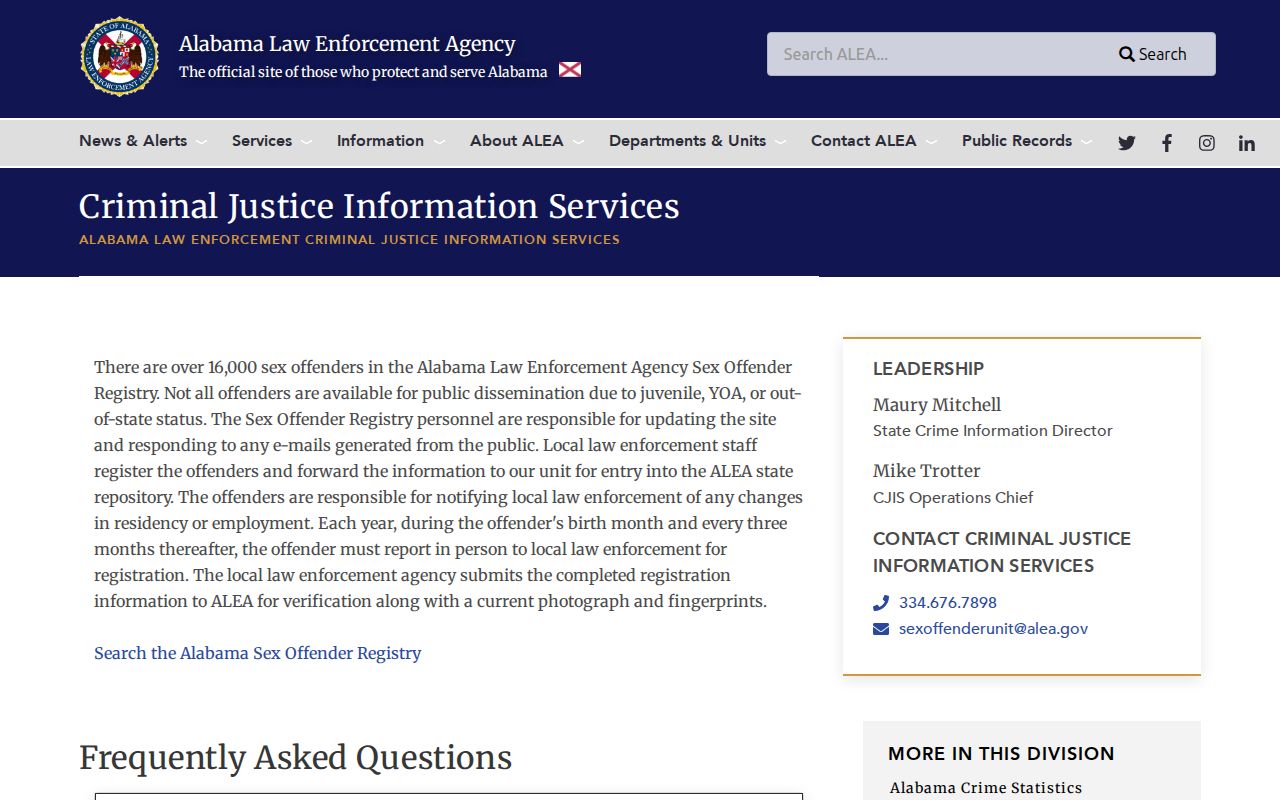 Its guidance connects a Monroe County public result to Monroe County law enforcement verification.
Searching the Alabama Sex Offender Registry
The ALEA portal is free and may present conditions before Monroe County results. Use the county control for a broad Monroe County check, then narrow only when needed. Search behavior and exact radius choices can change, so follow the live form rather than assuming a partial name or distance works in a set way.
- Open the official Monroe County public registry search and read any acceptance or use notice.
- Enter a name or choose Monroe County, then add a city, ZIP Code, or address filter if the live form supports it.
- Compare the Monroe County result list with known identifiers. Do not rely on a name alone.
- Open the Monroe County profile and read the offense, jurisdiction, address, registration status, and verification information together.
| Field Label | Type | Required | Notes |
|---|---|---|---|
| Name | Text | No | Use the behavior stated by the live form for a Monroe County name. |
| County | Dropdown | No | Choose Monroe for a Monroe County result set. |
| City | Text or dropdown | No | Spelling matters for a Monroe County city. |
| ZIP Code | Text | No | Use a five-digit Monroe County geographic filter. |
| Address and radius | Address fields and control | No | Use only radii shown for the Monroe County address. |
Some Monroe Registry Records Stay Unlisted
An empty Monroe County result is not proof that no relevant conviction exists. ALEA lists Monroe County public-display exclusions and limits. These can involve juvenile adjudications, Youthful Offender treatment, certain first convictions for sexual misconduct or indecent exposure, and some out-of-state, federal, military, or tribal convictions while Alabama completes the required due-process determination.
Public placement for a covered Monroe County offense generally begins after conviction and release to probation or at the end of a sentence. A Monroe County registry search answers who appears under Alabama's dissemination rules at that time. It is not a full criminal history search, and an unlisted person cannot be assumed to have no Monroe County court record.
The official ALEA search form shows the public entry point without focusing on any listed individual. 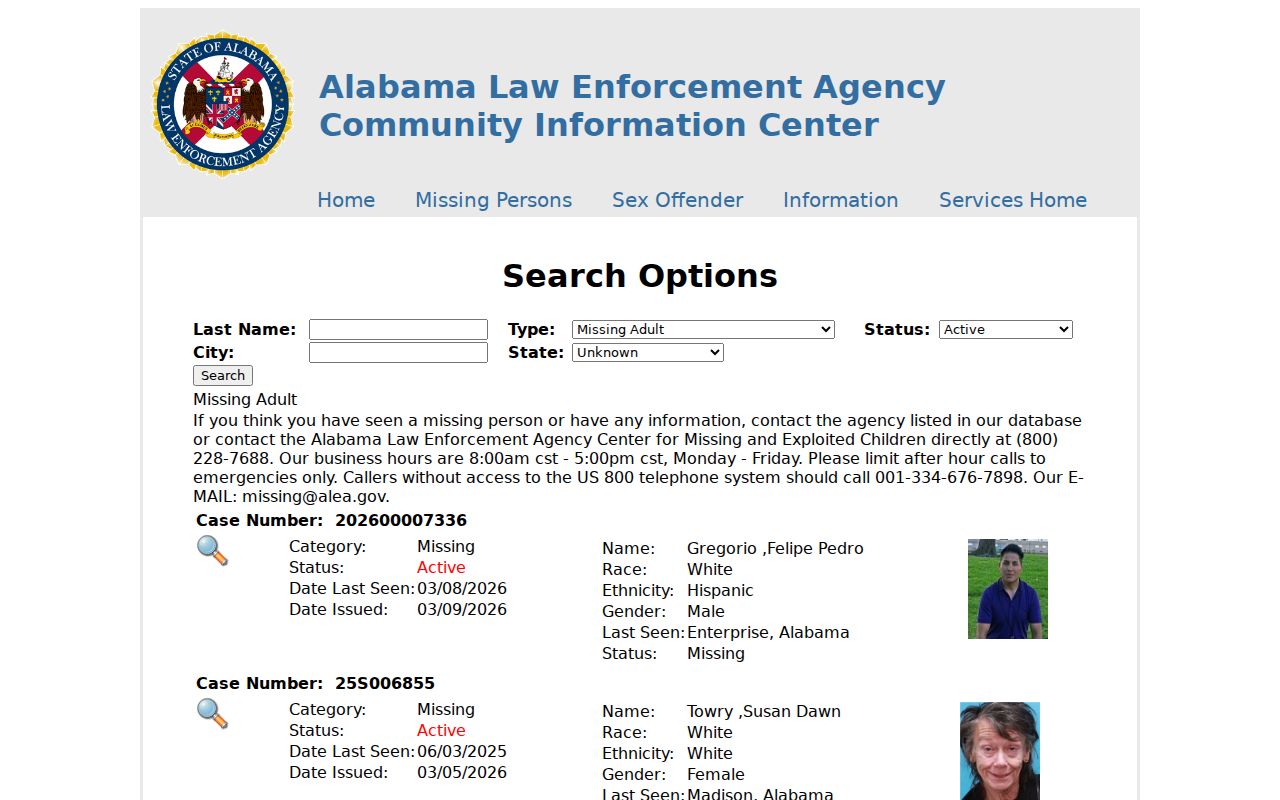 The form's county and place controls are the sound route for a Monroe County safety search.
What a Registry Profile Shows
A Monroe County registry profile may combine identity, place, registration, and offense fields. The exact field set varies with what Alabama law authorizes for that category. Physical details help distinguish people with similar names. Offense and jurisdiction data identify the event tied to registration, while the court record supplies the fuller legal history.
Read all Monroe County fields as a unit. A photograph and description aid identity but do not establish a current location alone. Monroe County residence data reflects what the registering agency submitted. Status text says what the registry records, not why a change occurred. Schools, work sites, vehicles, or marks appear only when Alabama law makes them public.
| Name and Aliases | Names reported for Monroe County identity matching. |
|---|---|
| Photo and Description | The Monroe County submission plus authorized marks or tattoos. |
| Residence | Monroe County address data Alabama law makes public. |
| Offense and Statute | The Monroe County profile's offense, jurisdiction, date, and authorized victim-age category. |
| Other Places and Vehicles | Monroe County school, work, or vehicle data when public. |
| Registration Status | The Monroe County jurisdiction and recorded compliance status. |
Monroe Registry and NSOPW Compared
ALEA is the source for an Alabama profile and Monroe County filter. The National Sex Offender Public Website, operated by the U.S. Department of Justice, searches participating jurisdictions when a Monroe County address history crosses state lines. NSOPW offers address-radius options of one, two, or three miles, but Monroe County proximity results depend on usable coordinates.
The national search is a second layer, not a replacement for the source registry. Use it to find a possible jurisdiction, then open that jurisdiction's official record for the current details and rules. The national portal's public search screen demonstrates this cross-state role. 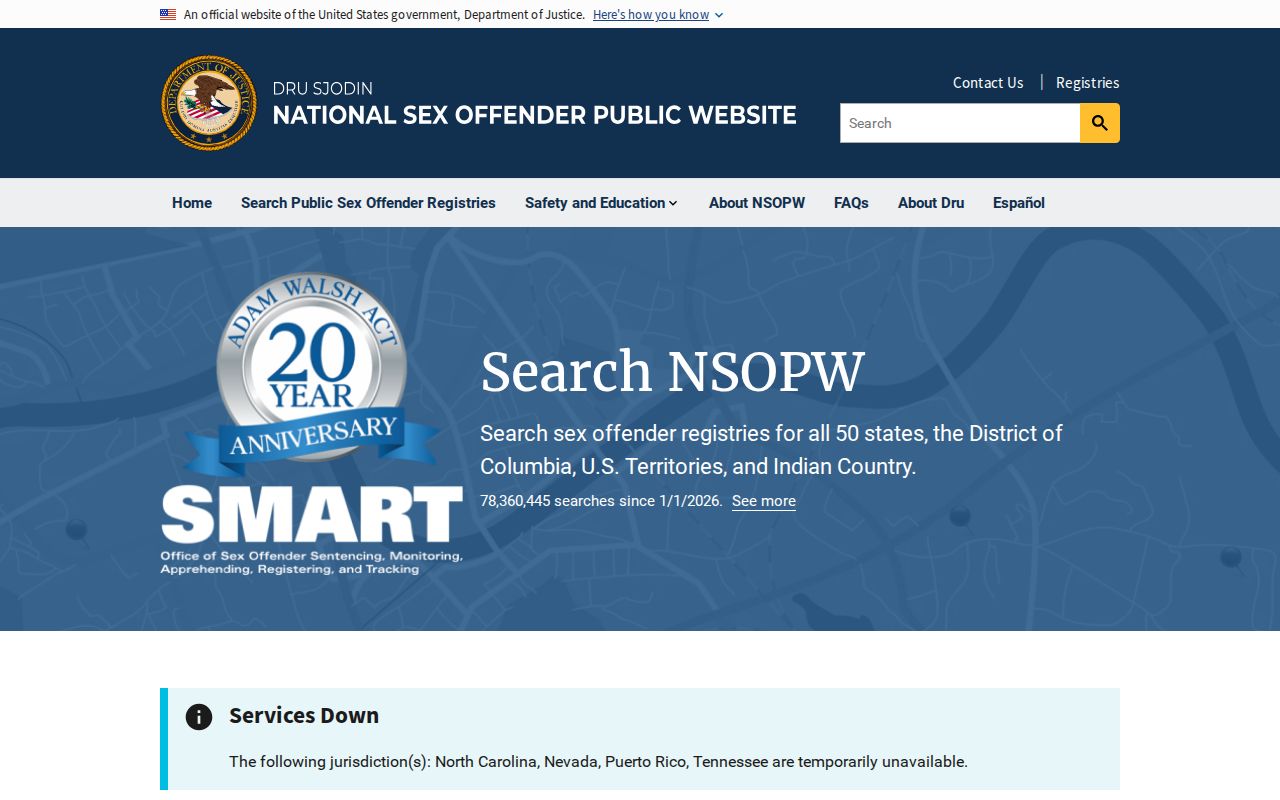 For a person tied only to Monroe County, ALEA remains the most direct profile source.
Registration Requirements and Levels in Alabama
Monroe County does not use a simple federal Tier I, II, or III filter. Alabama's ASORCNA uses adult, juvenile, Youthful Offender, and other statutory categories. Covered Monroe County adults generally register and verify for life, subject to narrow judicial relief. ALEA says an offender reports in the birth month and every three months after that. Section 15-20A-22 also sets a $10 payment to each registering agency at quarterly registration and when a residence is established or ended, with installment terms in the statute.
| Alabama Category | Duration and Public Effect | Verification |
|---|---|---|
| Covered adult sex offender | Monroe County duty is generally life, subject to statutory relief | In person during birth month and every three months thereafter |
| First registration-only sexual misconduct or indecent exposure case | May not appear publicly in Monroe County, though duties can remain | As required by the applicable Alabama provision |
| Juvenile, age 14 or older, specified most-serious offense | Monroe County duty is generally life; petition possible after 25 years | Under juvenile provisions and risk findings |
| Other juvenile sex-offender registration | Generally 10 years in Monroe County under Section 15-20A-28 | Under the juvenile registration provisions |
| Youthful Offender or specified outside conviction | Monroe County public status depends on age, offense, and findings | As the controlling statutory category requires |
Monroe County Registry Distance Rules
In Monroe County, Alabama Code Section 15-20A-11 generally bars a covered adult from establishing a residence within 2,000 feet of a school, childcare facility, or resident camp, measured from property line to property line. Statutory definitions and exceptions matter, so a Monroe County map estimate alone cannot settle whether an address complies. Local law enforcement can route a genuine concern to the right registration officer.
Residence limits and community notice are different rules. The limit governs where a covered person may live. Notice under Section 15-20A-21 sets who receives information and how far the agency sends it. Mixing the two distances can make a Monroe County search seem inconsistent when the law is answering two distinct questions.
Monroe County Registry Notification Radius
Community notice changes with municipality size. In a city of at least 5,000 residents, the police chief, or the sheriff when there is no chief, notifies residences within 1,500 feet and schools or childcare facilities within three miles. In a smaller town or an unincorporated part of Monroe County, the sheriff's residential radius is 2,000 feet, while the institutional radius remains three miles.
Monroeville's official 2024 estimate exceeds the 5,000-person threshold. Frisco City and Excel do not. That population split affects the statutory notice route, not whether someone appears in a countywide ALEA search. ALEA warns that its website does not replace community notification.
Within Monroeville, the city police chief ordinarily performs the notice role described for a municipality above the threshold. In Frisco City, Excel, and unincorporated Monroe County, the smaller-place rule places the residential notice radius at 2,000 feet through the sheriff. Schools and childcare facilities remain within the three-mile institutional notice radius in both settings. Population changes should be checked against current official figures when the threshold matters.
The ALEA Community Information Center groups registry, fugitive, and public alert functions. 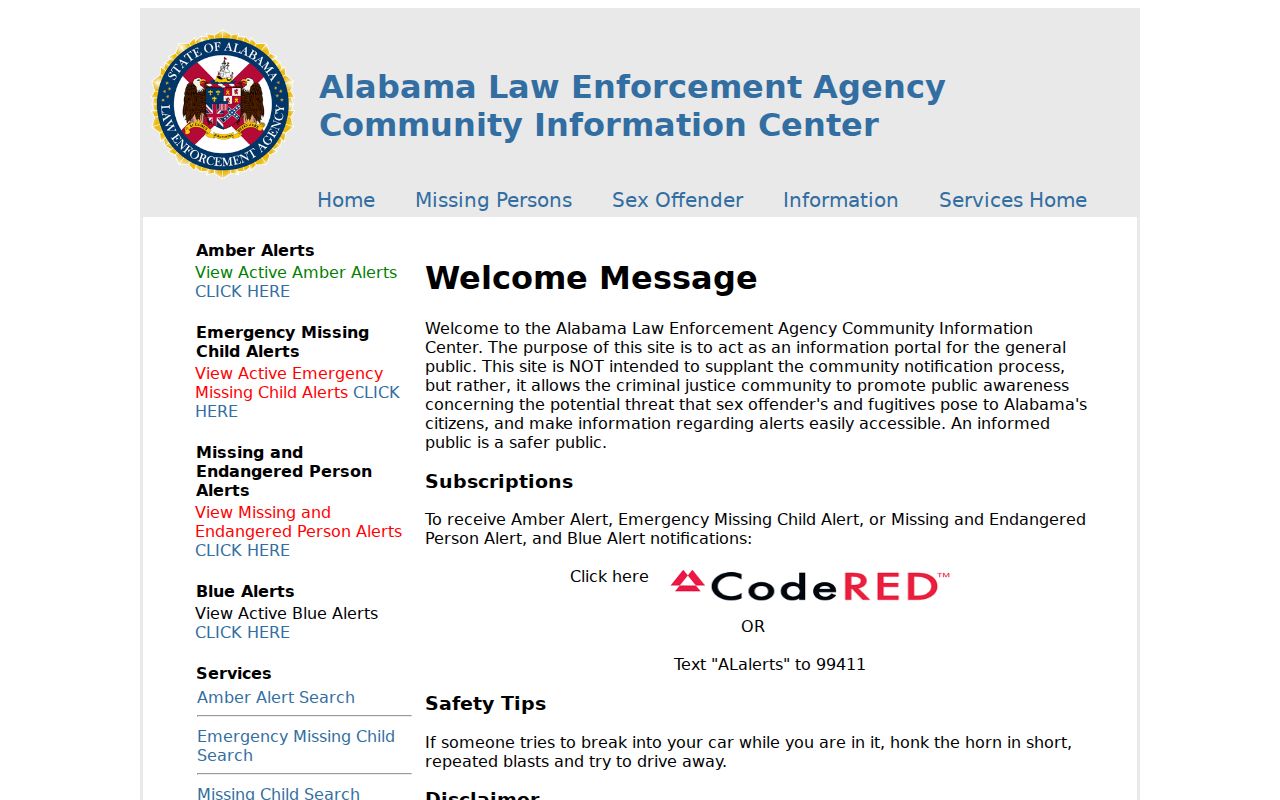 That menu is a useful official starting point, while local notice remains an agency duty under Alabama law.
Lawful Use and Community Notification
Use a Monroe County registry result for awareness and practical safety planning. Confirm details through ALEA and the registration agency. If an address seems wrong, record the public profile information, the date viewed, and the specific mismatch. Call the Monroe County sheriff at 251-575-2963 or the city police agency that handles that location. An emergency belongs with 911.
The official Monroe CSO app on Google Play and the Apple App Store lists a Sex Offenders function and a tip channel. Its optional tip fields include contact details, a narrative, GPS location, incident time, and images. The app can route information, but it does not turn a member of the public into an investigator. Use precise facts and let law enforcement assess compliance.
Misuse Is Unlawful: Monroe County registry information must not be used to harass, threaten, intimidate, confront, or commit another crime against a listed person or household. Alabama Code Sections 15-20A-8 and 15-20A-42 govern public dissemination and lawful official use.